
Keyword Search
Keyword Analysis (SEO)
Understanding how users search is an important part of creating relevant content and improving online visibility. For this project, I conducted a keyword analysis based on a selected persona and used tools such as Google Trends, Ubersuggest, Google Autosuggest, and AnswerThePublic to identify relevant search terms and search behaviour.
The purpose of the analysis was to understand what my target audience is searching for and how those insights can be used to optimise website content and improve search engine visibility.

Target Audience Analysis
Who is the target audience?
For this project, I used the persona Tanja Bjerring as my primary target audience. Tanja is a business owner with a background in Human Resources who regularly uses Google, LinkedIn, and social media to find inspiration, ideas, and potential collaborators.
What are her needs?
- Professional and trustworthy communication
- Practical marketing solutions
- Inspiration and new ideas
- Visibility and business growth
- Easy access to relevant information
How does this affect keyword selection?
The chosen keywords focus on topics related to SEO, digital marketing, social media, and online visibility, as these are areas likely to be relevant to a business owner seeking support and inspiration.
Brainstorming
The brainstorming process began with my chosen persona, Tanja Bjerring, a business owner who regularly uses Google, LinkedIn, and social media to find inspiration, solutions, and professional connections. I considered both her interests and needs, as well as the content and competencies presented on my website.
The goal was to identify keywords that are relevant to both the target audience and the topics I can realistically provide value on. Rather than focusing solely on high-volume search terms, I prioritised keywords related to digital marketing, SEO, social media, communication, and branding, as these areas are represented throughout my portfolio projects and coursework.
The brainstorm served as the foundation for the following keyword research and helped identify which topics were most relevant to investigate further using tools such as Google Trends, Ubersuggest, Google Autosuggest, and AnswerThePublic.
Google Trends
Google Trends was used to compare different keyword variations and identify which search terms are most commonly used by users. The tool provides insight into search interest over time and helps determine which keywords are most relevant to prioritise in a content strategy.
To ensure the results were not influenced by my personal search history, all searches were conducted in an incognito browser window. This helped provide a more objective view of search behaviour and keyword popularity.
The following comparisons were carried out to identify the strongest keyword variations within the categories SEO, Digital Marketing, and Social Media.
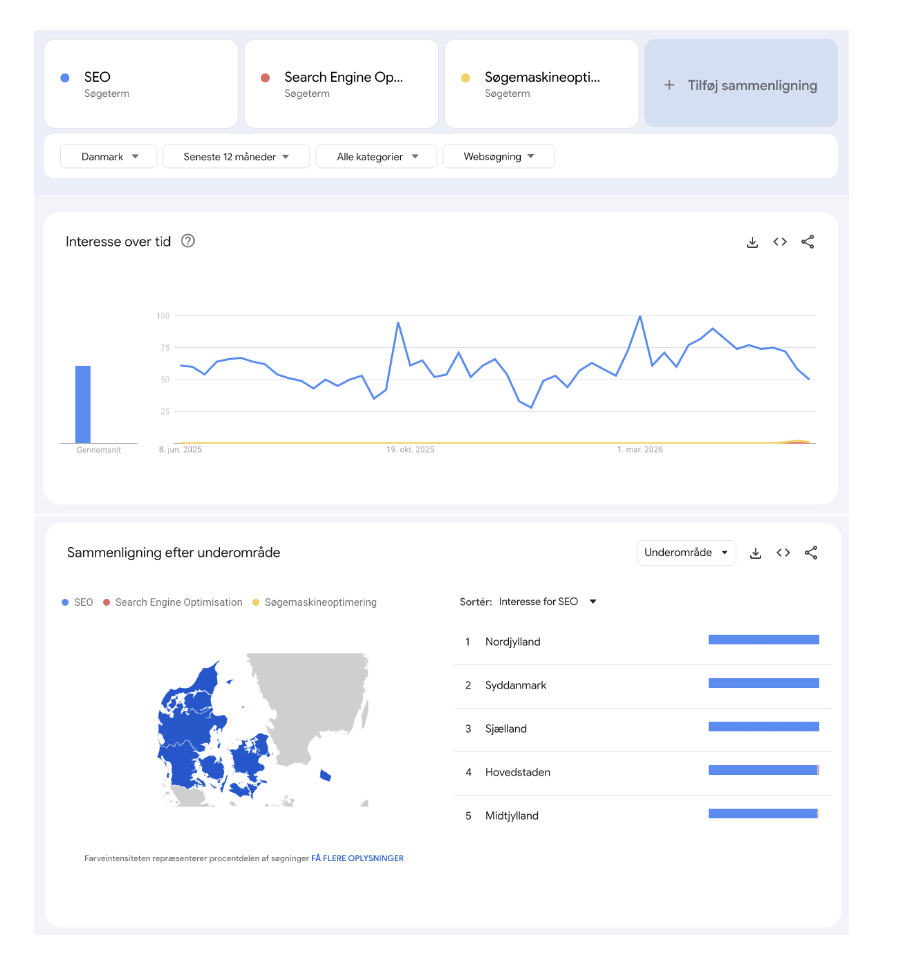
SEO vs. Søgemaskineoptimering vs. Search Engine Optimization
To identify the most relevant keyword variation, I compared the search terms SEO, Søgemaskineoptimering, and Search Engine Optimization using Google Trends. The analysis was conducted in Denmark over the past 12 months.
The results clearly show that SEO is the dominant search term throughout the entire period. Both the Danish and English full-length versions receive very limited search interest compared to the abbreviation SEO.
The regional comparison further confirms that SEO is consistently used across all regions of Denmark, demonstrating that the term is widely recognised and used by searchers nationwide.
Based on these findings, SEO was selected as the primary keyword for the website and the subsequent keyword analysis, as it reflects the terminology most commonly used by the target audience.
Digital Marketing vs. Digital Markedsføring
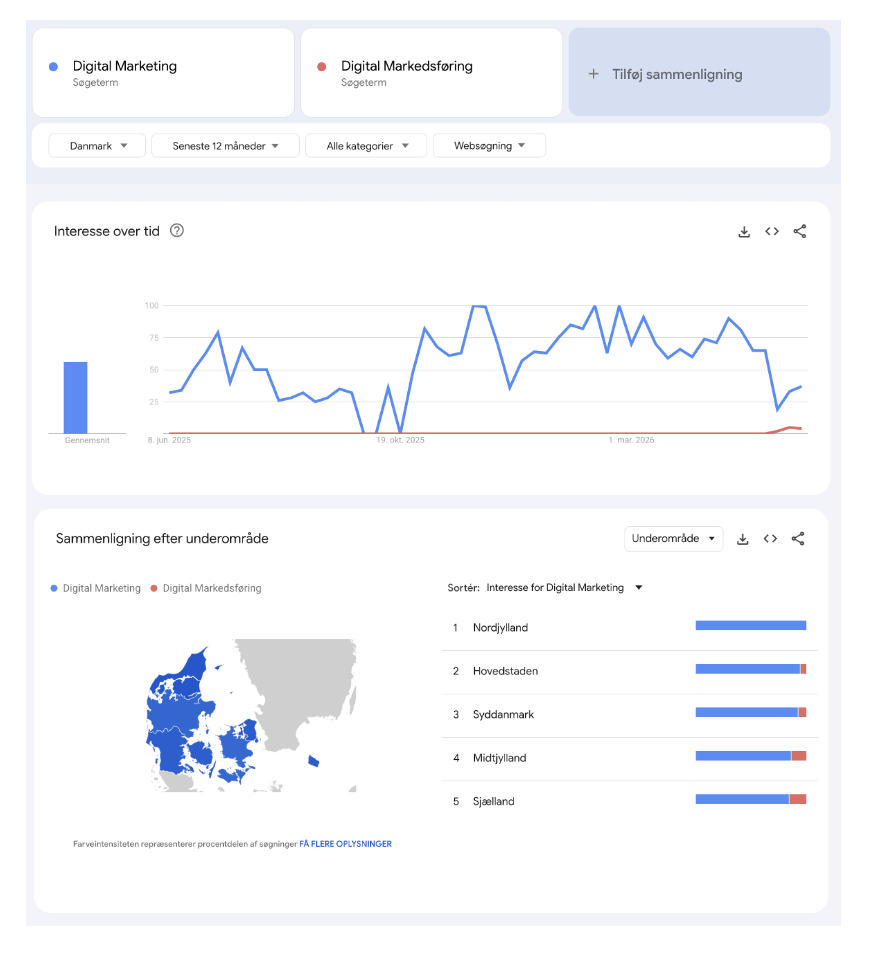
To identify the most relevant keyword variation, I compared the search terms Digital Marketing and Digital Markedsføring using Google Trends. The analysis was conducted in Denmark over the past 12 months.
The results show a clear preference for the English term Digital Marketing, which consistently generates significantly higher search interest than the Danish translation. Throughout the entire period, Digital Marketing maintained a strong level of search activity, while Digital Markedsføring received very limited search interest.
The regional comparison further confirms that Digital Marketing is the preferred search term across all regions of Denmark, demonstrating that English marketing terminology is widely adopted among Danish users.
Based on these findings, Digital Marketing was selected as the preferred keyword for the website and the subsequent keyword analysis, as it reflects the terminology most commonly used by the target audience.
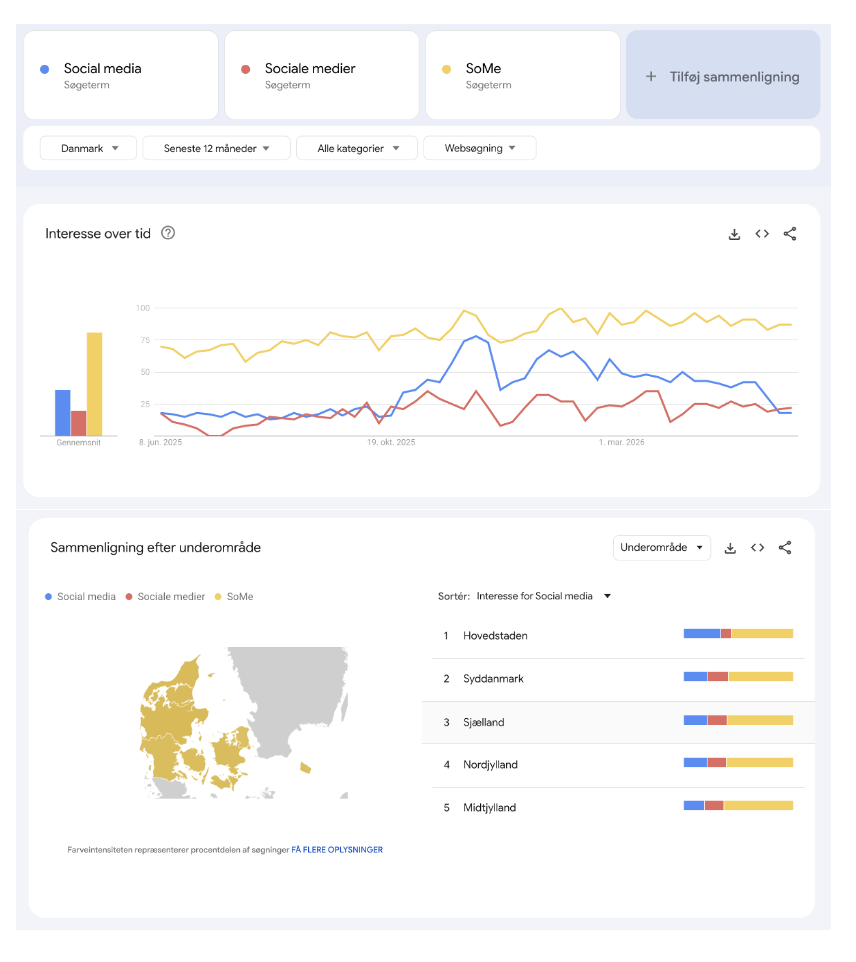
Social Media vs. Sociale Medier vs. SoMe
To identify the most relevant keyword variation, I compared the search terms Social Media, Sociale Medier, and SoMe using Google Trends. The analysis was conducted in Denmark over the past 12 months.
The results show that SoMe consistently generates the highest search interest among the three terms. While Social Media also receives a noticeable level of search activity, the Danish term Sociale Medier is searched less frequently throughout the period.
The regional comparison further confirms that SoMe is the dominant term across all regions of Denmark, indicating that the abbreviation is widely recognised and commonly used by Danish searchers.
Based on these findings, SoMe was identified as the most popular search term. However, as Social Media is more internationally recognised and aligns better with the language used throughout the website, it remains a relevant keyword within the overall content strategy.
Google Autosuggest, Related Searches and People Also Ask
To gain a deeper understanding of user search behaviour, I used Google Autosuggest, Related Searches, and Google’s People Also Ask feature. These tools provide valuable insight into the words, phrases, and questions users commonly search for when exploring a specific topic.
Google Autosuggest helps identify popular search terms and keyword variations, while Related Searches reveal additional topics connected to the original search. The People Also Ask section highlights common questions and information needs, providing insight into user intent and potential content opportunities.
Together, these tools helped identify relevant short-tail keywords, long-tail keywords, and frequently asked questions that could be used to support the keyword analysis and content strategy for the website.
SEO
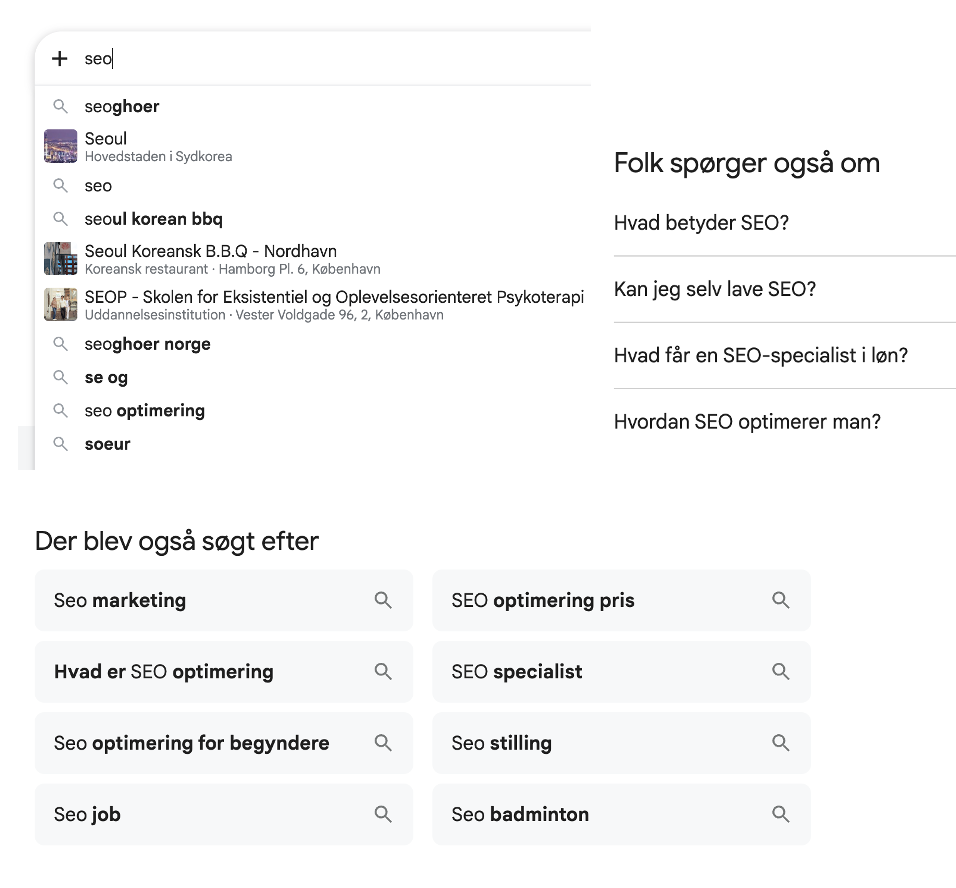
When searching for SEO, Google Autosuggest suggests terms such as SEO specialist, SEO pricing, and SEO for beginners. These suggestions indicate that users are interested in both learning about SEO and finding professional SEO services.
The related searches further support this trend, as they include topics connected to SEO optimisation, specialist roles, and career opportunities within the field. Google’s People Also Ask section highlights common questions such as what SEO means, how SEO works, and whether users can perform SEO themselves.
These findings suggest that users are searching for both basic SEO knowledge and practical guidance. The results helped identify relevant short-tail keywords and long-tail questions that were later included in the keyword analysis.
Digital Marketing
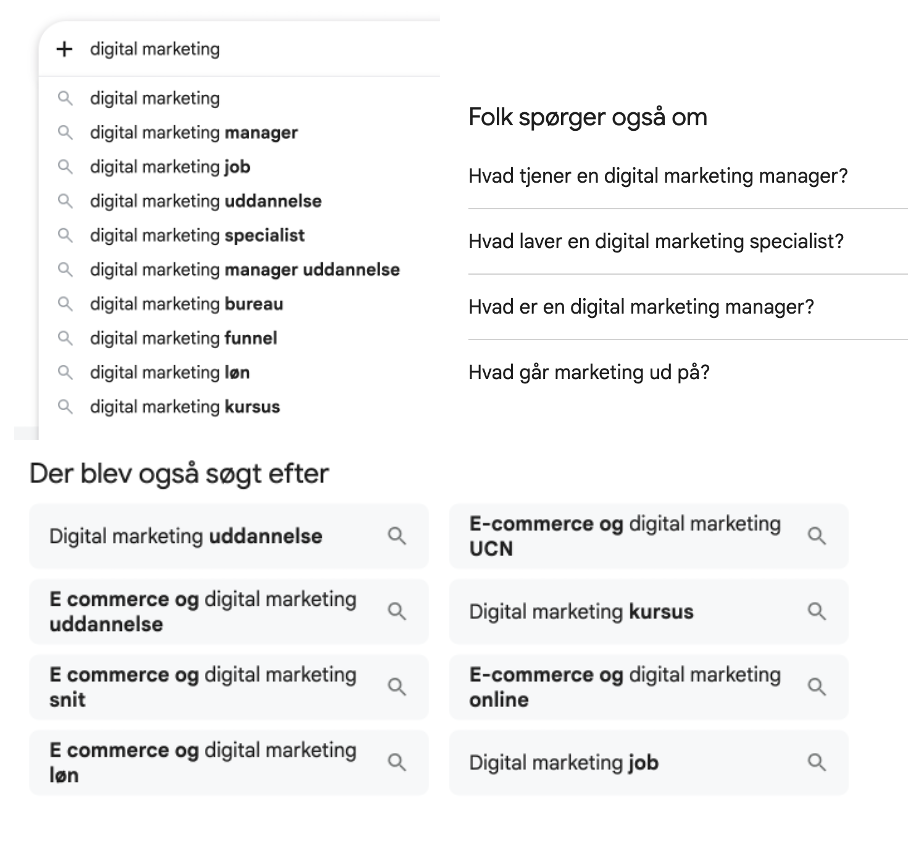
When searching for Digital Marketing, Google Autosuggest suggests terms such as Digital Marketing Manager, Digital Marketing Specialist, Digital Marketing Course, and Digital Marketing Agency. These suggestions indicate that users are interested in both career opportunities and professional services within the field.
The related searches further support this trend, as they include topics related to education, e-commerce, courses, and job opportunities. Google’s People Also Ask section highlights common questions about what digital marketing is, what digital marketing specialists do, and how digital marketing works.
These findings suggest that users are seeking both introductory knowledge and practical insights into digital marketing. The results helped identify relevant short-tail keywords and long-tail questions that were later included in the keyword analysis.
Social Media
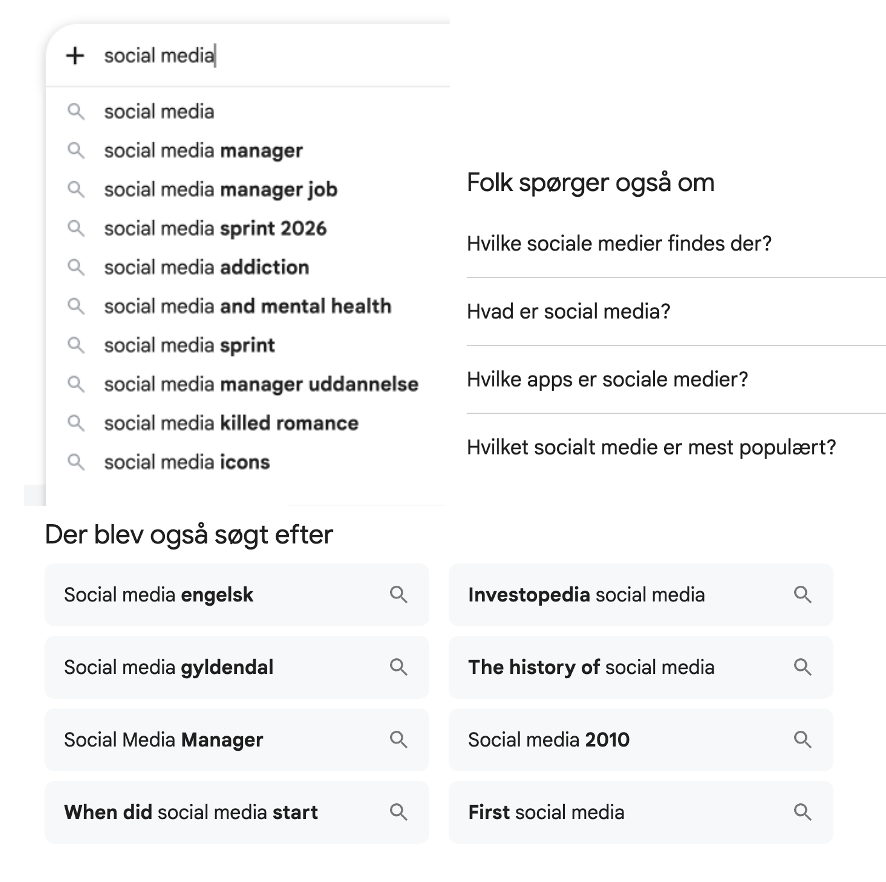
When searching for Social Media, Google Autosuggest suggests terms such as Social Media Manager, Social Media Manager Job, and Social Media Manager Education. These suggestions indicate that users are interested in both career opportunities and professional roles within social media.
The related searches show interest in topics such as the history of social media, social media platforms, and social media management. Google’s People Also Ask section highlights common questions about what social media is, which social media platforms exist, and which social media channels are currently the most popular.
These findings suggest that users are searching for both general knowledge and practical information about social media. The results helped identify relevant short-tail keywords and long-tail questions that were later included in the keyword analysis.
Final Keyword Selection
Based on the keyword research process, I selected a range of short-tail keywords and user questions that are relevant to both my target audience and the content of my website.
Google Trends, Google Autosuggest and People Also Ask were used to identify common themes and search behaviour. Rather than selecting the suggested search terms directly, the results showed that users are primarily interested in learning more about SEO, digital marketing and social media. This insight was then used to develop a series of relevant user-focused questions that reflect the information needs of my persona.
Where available, Ubersuggest was used to evaluate search volume, competition and CPC. For some of the user questions, no search volume data was available. These questions were still included because they align with the interests and challenges identified through the research process.
The final keyword selection provides the foundation for the On-Page SEO optimisation carried out in Step 3, where the selected keywords and topics are incorporated into website content, headings, SEO titles and meta descriptions.